
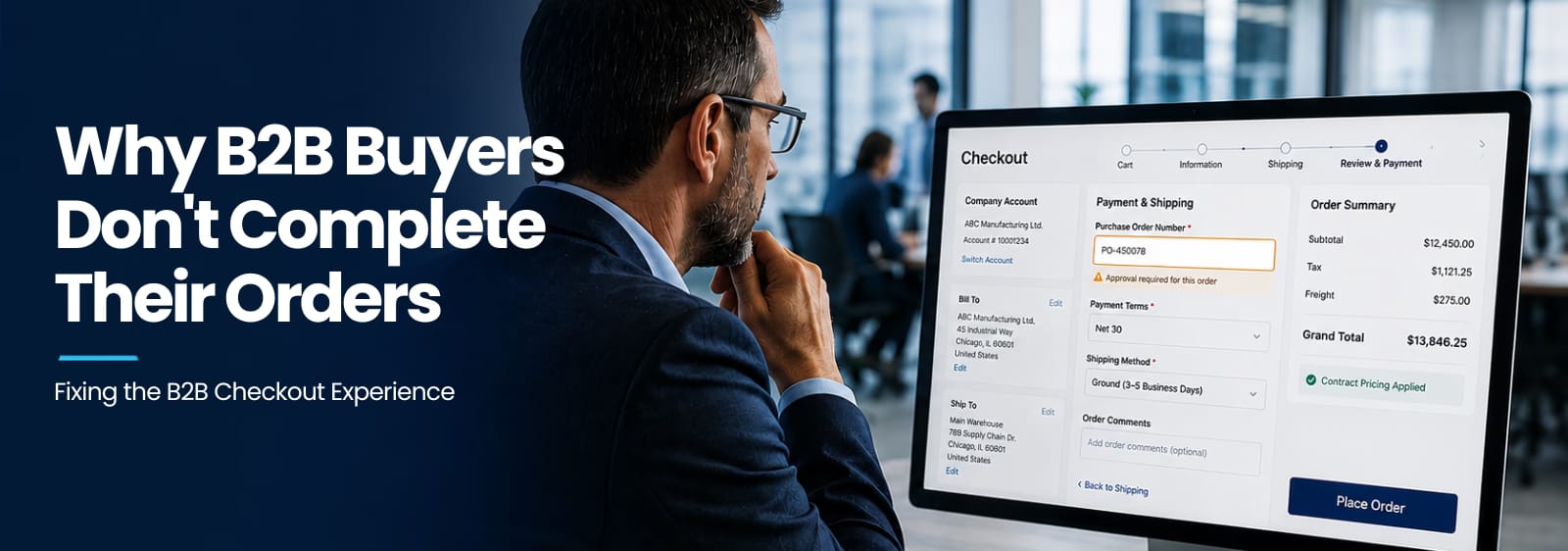
For many wholesale businesses, a healthy order book can hide an unhealthy buying experience.
We've reviewed B2B commerce platforms where online traffic was increasing, repeat customers logged in regularly, and shopping carts were filled with high-value orders. On paper, everything looked positive. Yet sales teams were still spending hours each day processing purchase orders received by email, customer service teams were answering routine ordering questions, and finance teams were manually checking pricing before invoices could be issued.
Nothing appeared broken, but the digital channel wasn't delivering the efficiency the business expected.
Table of Contents
- Checkout Isn't Where Most Problems Begin
- Why Wholesale Buyers Evaluate Checkout Differently
- Traditional vs Modern B2B Buying Journey
- The Cost of Checkout Friction Goes Beyond Abandoned Carts
- The Checkout Reflects Every Decision Made Earlier in the Buying Journey
- Procurement Doesn't Stop at the Checkout Page
- Buyers Judge Reliability Long Before They Judge Design
- Connected Systems Create Better Buying Experiences
- Technology Doesn't Fix a Broken Buying Process
- What Buyers Really Expect From a Modern B2B Checkout
- The Best Checkout Experience Is the One Buyers Stop Thinking About
- Where We Usually Begin
- Conclusion
- Frequently Asked Questions
The common assumption is that buyers simply prefer speaking to their account manager or that procurement teams are reluctant to change established habits. While that can occasionally be true, it rarely explains why customers who have already invested time building an online order choose not to complete it. In most cases, the issue isn't a lack of confidence in online purchasing. It's a lack of confidence in the checkout process itself.
That distinction is important because an abandoned checkout doesn't always represent a lost customer. More often, it represents a customer who no longer trusts the website to complete the transaction accurately. The order eventually arrives through another channel, but the business pays for that decision through additional administration, slower processing, and unnecessary manual intervention.
When businesses measure only online conversion rates, they rarely see those hidden costs. Revenue may remain stable, but operational efficiency quietly declines. That shift is already happening across B2B commerce. According to the B2B eCommerce Association, business buyers increasingly expect digital purchasing experiences to support negotiated pricing, payment terms, and self-service ordering without relying on sales teams. As more procurement teams adopt digital-first buying habits, businesses that continue to depend on manual order processing risk creating unnecessary friction for both customers and internal teams.
Checkout Isn't Where Most Problems Begin
One pattern we've noticed across wholesale commerce projects is that checkout often receives attention for the wrong reasons.
When conversion rates start falling, teams instinctively look at the payment page. They simplify forms, redesign buttons, introduce additional payment gateways, or shorten the number of checkout steps. Those improvements can certainly help, but they're often solving the symptom rather than the underlying problem.
Buyers usually decide whether they trust your checkout long before they reach it.
Consider a procurement manager placing a routine replenishment order. They've already agreed commercial terms with your business, know which products they need, and have internal approval to purchase. At that stage, they're not evaluating your website in the same way a retail customer compares different online stores. They're simply trying to complete a familiar business process with as little friction as possible.
Now imagine what happens if the pricing shown online doesn't match the negotiated agreement stored in your ERP. Inventory availability differs from what the sales team confirmed earlier that day. The platform requires immediate card payment despite an existing Net 30 agreement, or there's no obvious way to include a purchase order reference that finance requires before approving the invoice.
Individually, none of these issues appears particularly significant.
Together, they introduce doubt.
Procurement professionals are trained to avoid uncertainty. If something doesn't look right, they don't gamble on it. They pause, verify the details, and often move the purchase back to email or phone where they know exceptions can be handled quickly.
That's why we encourage clients to look beyond the checkout page itself. In many cases, what appears to be a checkout problem is actually the final consequence of disconnected systems, incomplete customer data, or purchasing workflows that were never designed around B2B buying behavior.
Why Wholesale Buyers Evaluate Checkout Differently
One of the biggest misconceptions in digital commerce is that B2B buyers behave like retail customers with larger baskets.
The reality is far more nuanced.
Consumer purchases are usually driven by convenience, price, and speed. Wholesale purchases are driven by process.
By the time a buyer reaches checkout, the commercial decision has often been made days or even weeks earlier. Product specifications have been reviewed. Pricing has been negotiated. Budgets have been approved. Internal stakeholders have agreed the purchase should go ahead.
The checkout isn't expected to persuade the customer to buy.
It's expected to help them complete an approved transaction without creating additional work.
That difference changes almost everything.
For example, reducing checkout from four steps to two may improve the experience for retail shoppers, but it does little for a procurement team if the platform still can't support company accounts, approval workflows, customer-specific pricing, or agreed payment terms.
In fact, we've seen businesses invest heavily in redesigning the visual experience while leaving the operational buying process almost untouched. The website looked modern, loaded quickly, and offered an intuitive interface, yet buyers continued sending spreadsheets to their account managers because rebuilding large orders online every month simply took longer than emailing them.
Technology wasn't the barrier.
The workflow was.

Traditional vs Modern B2B Buying Journey
| Traditional Purchasing Process | Modern Self-Service B2B Commerce |
|---|---|
| Buyer emails sales representative | Buyer logs into company account |
| Pricing confirmed manually | Customer-specific pricing displayed automatically |
| Purchase order shared by email | Purchase order entered during checkout |
| Sales team verifies payment terms | Agreed payment terms applied automatically |
| Manual approval outside the platform | Built-in approval workflows |
| Order entered manually into ERP | Order synchronized with ERP instantly |
| Customer waits for confirmation | Immediate order confirmation and status updates |
The objective isn't to remove sales teams from the buying process. It's to remove unnecessary administrative work so buyers can complete routine purchases independently while sales teams focus on strategic customer relationships.
The Cost of Checkout Friction Goes Beyond Abandoned Carts
Most analytics platforms tell you how many visitors reached checkout and how many completed an order. That's useful information, but it only tells part of the story.
- What those reports don't show is what happened next.
- Did the customer give up completely?
- Did they call their sales representative?
- Did they email a purchase order?
- Did someone from customer service manually recreate the basket?
Those scenarios produce very different business outcomes, yet many organizations classify them all as cart abandonment.
From an operational perspective, they're anything but identical.
We've worked with businesses where more than half of the orders labeled as "abandoned" eventually arrived through another channel. Revenue wasn't disappearing. Efficiency was.
Sales representatives became order administrators instead of focusing on strategic accounts. Finance teams manually checked pricing because customers questioned what they saw online. Customer service spent valuable time resolving issues that should have been handled automatically by the platform.
None of those costs appear in a conversion report.
The impact extends well beyond online conversion metrics. Industry research consistently shows that B2B buyers increasingly prefer digital self-service when it reflects the commercial relationship they've already established with a supplier. Every order that moves back to email, spreadsheets, or manual processing increases internal costs while reducing the efficiency gains businesses expect from their commerce platform.
They appear in payroll, slower fulfillment, and a buying experience that quietly encourages customers to avoid self-service ordering.
This is one reason the findings published by the B2B eCommerce Association are particularly relevant. The research highlights that buyers increasingly expect checkout to support the way their organizations already purchase, including transparent pricing, payment terms, and business-friendly ordering processes. Those expectations reflect a broader shift in B2B commerce. Buyers aren't asking for consumer-style simplicity at the expense of business controls. They're looking for technology that removes unnecessary friction while respecting established procurement workflows.
When those expectations are met, online ordering becomes the fastest and easiest option.
When they aren't, customers don't necessarily stop buying.
They simply stop buying online.
The Checkout Reflects Every Decision Made Earlier in the Buying Journey
One misconception we encounter during B2B commerce audits is that checkout exists as a separate part of the website. In practice, it's simply the point where every earlier decision either holds together or falls apart.
Take pricing as an example.
Many wholesale businesses invest significant time negotiating customer contracts, creating tiered discounts, or agreeing special rates for key accounts. Those agreements often live inside an ERP system or are managed manually by the sales team. Buyers assume those same commercial terms will appear online because, from their perspective, they're already part of the relationship.
When they don't, confidence disappears surprisingly quickly.
We've seen buyers stop an order worth several thousand dollars simply because one product appeared at the standard catalogue price instead of the contracted rate. The issue wasn't the price itself. It was uncertainty. If one line item looked incorrect, buyers naturally questioned whether freight charges, taxes, or the final invoice would also need manual verification.
That hesitation is understandable. Procurement teams aren't rewarded for taking risks. They're expected to follow established purchasing policies and avoid unnecessary exceptions.
This is why customer-specific pricing should never be treated as a marketing feature. In B2B commerce, it's part of the commercial agreement. The website isn't introducing a new price; it's accurately reflecting an existing one.
The same principle applies to payment terms. A customer who has traded with your business for years shouldn't arrive at checkout only to discover that the platform expects immediate card payment. From their perspective, the commercial relationship has suddenly disappeared. Even if the issue can be resolved with a quick phone call, the buying experience has already become more complicated than it needed to be.
Procurement Doesn't Stop at the Checkout Page
One difference between B2B and retail commerce is that checkout rarely marks the end of the purchasing process.
For many organizations, it's only one step in a broader procurement workflow.
A warehouse manager might prepare the order, but someone in procurement reviews it before it's submitted. Finance may need to verify the purchase order number, while a department head approves spending above a certain threshold. Larger organizations often involve several people before an order is finally released.
Those processes exist for good reason. They help businesses manage budgets, maintain compliance, and control purchasing across multiple departments or locations.
Problems arise when the commerce platform ignores those realities.
If buyers have to leave the website to email a spreadsheet for approval, request revised pricing, or wait for someone to manually recreate an order, self-service purchasing quickly loses its appeal. The online store becomes little more than a digital catalog, while the actual transaction still happens offline.
That's one reason purchase order workflows and account-based purchasing have become standard expectations rather than advanced functionality. Buyers want the platform to fit naturally into the way their organization already works. They don't expect procurement teams to redesign their internal processes simply because a website can't accommodate them.
When those workflows are built into the buying experience, something interesting happens. Customers stop thinking about the technology altogether. They focus on completing their work, which is exactly what a commerce platform should enable.
Buyers Judge Reliability Long Before They Judge Design
User experience discussions often revolve around visual design, navigation, or page speed. Those factors matter, but they're rarely the deciding factor for returning wholesale customers.
Reliability carries far more weight.
Buyers want to know that the information they're seeing is accurate. They expect inventory availability to reflect what's actually in stock, not what was available six hours ago. They assume delivery estimates are based on real fulfilment capacity rather than generic shipping rules. They also expect previous orders, saved shopping lists, and frequently purchased products to be available without rebuilding everything from scratch.
None of these features is particularly exciting from a design perspective.
Collectively, however, they determine whether buyers trust the platform enough to make it part of their everyday purchasing process.
We've reviewed commerce implementations where every visual aspect of the website had recently been redesigned, yet customer adoption remained disappointingly low. The reason wasn't difficult to uncover. Buyers still couldn't reorder products efficiently, inventory wasn't synchronised with the ERP, and sales teams regularly corrected pricing after orders were submitted.
The interface looked modern.
The buying experience didn't feel dependable.
Those are very different things.
Connected Systems Create Better Buying Experiences
Checkout performance is often discussed in terms of user interface improvements, but many of the biggest gains happen behind the scenes.
A buyer doesn't care whether pricing comes from Adobe Commerce, Magento, an ERP system, or a pricing engine. They care that it's correct. They don't need to know where inventory is managed, only that availability is accurate when they're placing an order.
That's why integration plays such an important role in B2B checkout optimization.
When customer accounts, pricing, inventory, tax rules, and payment terms are synchronized across business systems, buyers experience consistency from the moment they sign in until the order confirmation arrives. When those systems operate independently, inconsistencies inevitably appear, and checkout becomes the point where customers notice them.
We've found that many organizations underestimate this connection. They redesign storefronts while leaving operational systems untouched, expecting visual improvements to solve what are fundamentally data problems.
Rarely does that produce lasting results.
During our B2B eCommerce Development projects, one of the first exercises is mapping how information moves between commerce platforms, ERP systems, CRM software, and fulfillment operations. That process often uncovers small disconnects that individually seem insignificant but collectively create enough friction to discourage online purchasing.
By the time those issues reach checkout, the buyer has already encountered several moments that reduce confidence in the process.
Improving the checkout page alone won't solve that.
Improving the buying journey usually will.
Technology Doesn't Fix a Broken Buying Process
It's tempting to believe that upgrading your commerce platform will automatically improve the buying experience. We hear that expectation frequently during platform migrations. Businesses move to Adobe Commerce, upgrade Magento, or replace a legacy system hoping that conversion rates will improve simply because the technology is newer.
Sometimes they do.
Just as often, they don't.
The reason is straightforward. A new platform can modernize the technology, but it can't correct purchasing processes that were never designed around your customers in the first place.
Gartner has repeatedly highlighted that successful digital commerce initiatives depend as much on process redesign and organisational alignment as they do on technology investments. Replacing a platform without addressing underlying procurement workflows often modernises the interface while leaving the customer experience largely unchanged.
We've reviewed projects where businesses invested heavily in redesigning their storefront, introduced faster search, refreshed the user interface, and launched new checkout pages. Six months later, buyers were still emailing purchase orders and asking sales representatives to process routine replenishment orders.
Nothing was technically wrong with the platform.
It was faithfully supporting a process that no longer reflected how customers wanted to buy.
Before discussing features, it's worth asking a more fundamental question.
Does your digital buying journey mirror the way your customers actually purchase?
For many wholesale businesses, the honest answer is no.
The online store often reflects internal business processes rather than customer workflows. Buyers are expected to adapt to the platform instead of the platform adapting to established procurement practices.
That's where friction begins.
What Buyers Really Expect From a Modern B2B Checkout
Over the past decade, expectations have changed significantly. Buyers no longer compare your website only with another supplier. They compare every business application they use throughout the day.
They know procurement involves more complexity than consumer shopping, but they also expect technology to remove unnecessary administration rather than create more of it.
When we ask clients what they believe buyers want, the answers usually revolve around faster checkout or more payment methods.
When we speak with procurement teams, the conversation sounds quite different.
They want confidence that the information they're seeing is accurate.
They want to know that negotiated pricing will still be there next month. They expect inventory levels to reflect reality, not yesterday's warehouse update. They don't want to explain their payment terms every time they place an order, and they certainly don't want to rebuild the same shopping cart every week because the platform can't remember what their business orders regularly.
These expectations aren't driven by convenience.
They're driven by productivity.
Every extra phone call, spreadsheet, or manual approval adds time to a purchasing process that's already under pressure. Procurement teams measure success by how efficiently they can move approved purchases through the organization. If your website slows that process down, they'll naturally return to whatever method allows them to finish the job with the least amount of effort.
That's one reason the strongest B2B checkout experiences rarely feel complicated, even though they're handling sophisticated business rules in the background.
The complexity exists within the platform.
Not within the buying experience.
The Best Checkout Experience Is the One Buyers Stop Thinking About
One question we often ask during commerce workshops is surprisingly simple.
"What does a successful checkout look like for your customer?"
The answers usually focus on technology.
- Single-page checkout.
- Digital wallets.
- Guest checkout.
- Auto-complete forms.
Those capabilities have value, but they're rarely what wholesale buyers remember.
What buyers remember is whether they had to leave the website to complete the order.
If they needed to call someone to verify pricing, request an invoice, confirm inventory, or explain their payment terms, the checkout wasn't successful, regardless of how polished it looked.
The opposite is also true.
When everything works as expected, buyers rarely think about checkout at all.
They log in, see the correct catalogue, build their order, submit it for approval if required, receive confirmation, and continue with the rest of their day.
That's exactly how it should feel.
The technology fades into the background because it supports the buying process instead of interrupting it.
From our experience, that's the benchmark businesses should aim for.
Not the shortest checkout.
Not the most visually impressive checkout.
The most dependable one.
Where We Usually Begin
Clients sometimes ask us to redesign their checkout before we've looked at anything else.
It's understandable. Checkout is the visible part of the buying journey, so it feels like the logical place to start.
We usually take a different approach.
Before discussing layouts, payment gateways, or user interface improvements, we spend time understanding how customers actually buy.
- Which systems manage contract pricing?
- Where do purchase approvals happen?
- How are repeat orders placed today?
- What causes buyers to contact sales instead of completing an order online?
- Which information exists inside the ERP but never reaches the storefront?
Those conversations almost always reveal opportunities that wouldn't have been discovered by reviewing the checkout page alone.
That's why our Magento Development Services and Adobe Commerce Development engagements typically begin with workflow mapping rather than interface design. Once the purchasing journey is understood, technical decisions become much easier because they're based on customer behavior rather than assumptions.
In some projects, the solution involves redesigning checkout.
In others, it's synchronizing pricing, improving ERP integration, introducing company accounts, or enabling approval workflows that already exist outside the platform.
The objective remains the same.
Remove friction from the buying journey so customers can complete their work without relying on manual intervention.
Technology supports that goal.
It doesn't define it.
Conclusion
The conversation around B2B cart abandonment often starts with conversion rates and ends with checkout redesigns.
In our experience, that's rarely where the most meaningful improvements are found.
Wholesale buyers don't abandon online orders simply because a button is in the wrong place or a form contains one field too many. More often, they step away because the purchasing process doesn't reflect the commercial relationship you've already built with them. Contract pricing doesn't match expectations. Payment terms disappear. Internal approvals happen outside the platform. Information buyers rely on isn't available when they need it.
The checkout becomes the point where those gaps become impossible to ignore.
As digital procurement continues to become the preferred purchasing channel, organisations that reduce manual ordering and support self-service buying will be better positioned to improve operational efficiency while meeting changing buyer expectations.
If buyers can move from product selection to order confirmation without questioning pricing, inventory, payment terms, or procurement workflows, the platform becomes part of their everyday purchasing process rather than another system they have to work around.
That's ultimately what a successful B2B checkout experience should achieve.
Not just more completed orders.
A buying experience that customers trust enough to use again tomorrow.

Frequently Asked Questions
Why do B2B buyers abandon checkout even when they're ready to purchase?
Most buyers don't leave because they've changed their minds. They leave when the checkout process doesn't support the way their organization buys. Missing contract pricing, purchase order references, approval workflows, or agreed payment terms often force procurement teams to complete the purchase through email or a sales representative instead.
How is a B2B checkout different from a retail checkout?
Retail checkout is designed for individual consumers making immediate purchasing decisions. A B2B checkout experience needs to support business purchasing processes, including company accounts, customer-specific pricing, purchase order workflows, payment terms, approvals, and integration with ERP and CRM systems.
What has the biggest impact on B2B checkout optimization?
In our experience, improving checkout starts with understanding the wider buying journey. Businesses often achieve better results by synchronizing pricing, inventory, and customer account data than by simply redesigning the checkout page.
Does Adobe Commerce support B2B purchasing?
Yes. Adobe Commerce includes capabilities such as company accounts, shared catalogs, approval workflows, negotiated pricing, and purchase order support. However, those features deliver the best results when they're configured around your customers' procurement processes rather than enabled with default settings.
When should a business review its checkout process?
If customers regularly contact sales to place routine orders, question online pricing, request manual invoices, or abandon online purchases in favor of email orders, it's worth reviewing the entire buying journey rather than the checkout page alone.