
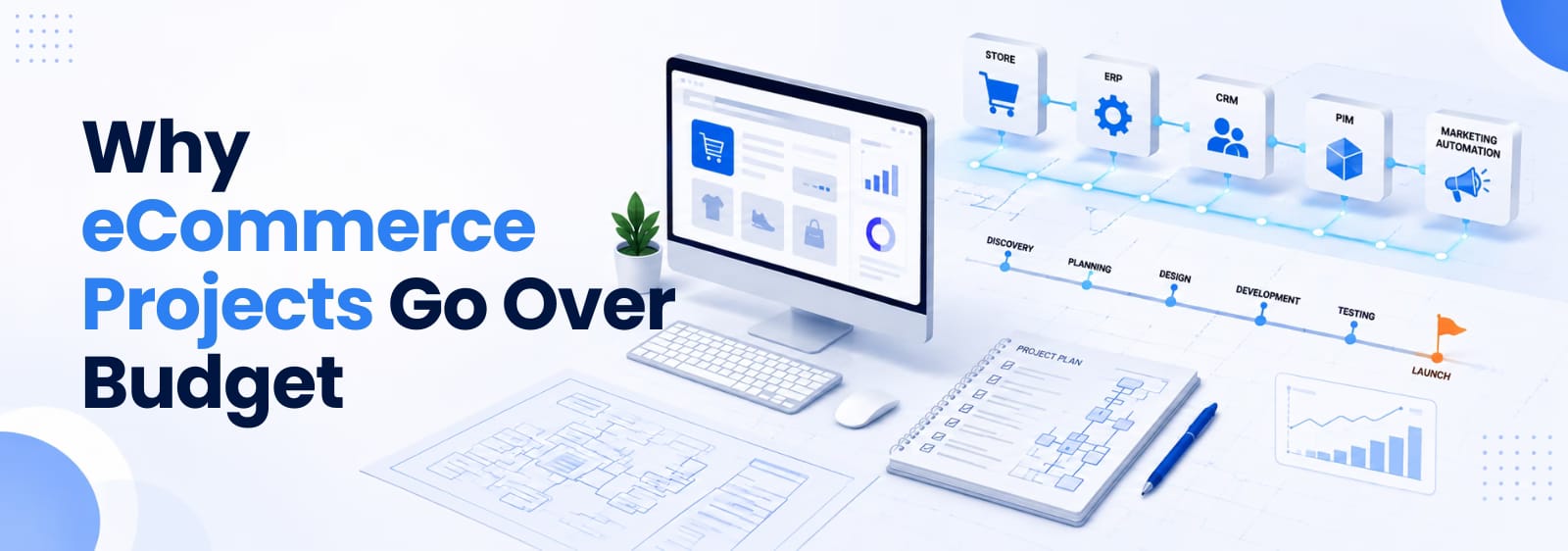
Ask ten eCommerce leaders how their last platform project went, and most will tell you the same story with different numbers attached. The build took longer than planned, the invoice grew past the original quote, and somewhere along the way "final scope" stopped meaning final. This isn't unique to any one platform or agency. Unfortunately, it's a common outcome for digital projects with any meaningful level of complexity, and understanding why is the first step toward budgeting one that doesn't follow the same pattern.
Research from Harvard Business Review, drawing on more than 1,400 IT and business transformation projects, found an average cost overrun of 27%, and that number hides a worse pattern underneath it: roughly one in six projects becomes what researchers call a "black swan," running 200% over budget on average. The Standish Group's long-running CHAOS research tells a similar story from a different angle. Only around 31% of technology projects finish on time, on budget, and with the originally agreed scope, a figure that has barely moved across three decades of tooling, methodology, and process improvements.
Table of Contents
- How Much Does an eCommerce Website Cost?
- The Five Real Reasons eCommerce Projects Go Over Budget
- The Hidden Costs Most eCommerce Budgets Miss
- How to Build an eCommerce Project Budget You Can Actually Trust
- Why Platform Choice Changes Your Budget Risk
- How Navigate Commerce Reduces Budget Risk Before Development Begins
- Start With Better Planning, Not a Bigger Budget
- FAQS
eCommerce implementations sit squarely inside this pattern, and Magento and Adobe Commerce projects (the platforms we work with daily at Navigate Commerce) are no exception. In this guide, we'll break down of where the money actually goes, why estimates fall apart, and what a realistic eCommerce project budget looks like once it's built by people who have delivered the work rather than just priced it.
Key Takeaways
- Most budget overruns begin during planning, not development.
- Discovery is one of the highest-return phases of an eCommerce project, not an optional pre-sales step.
- Integrations and data migration are the most common sources of hidden cost.
- Effective project governance ensures every change is evaluated for its impact on cost, timeline, and business priorities before development continues.
- Platform selection shapes long-term ownership cost as much as it shapes the initial quote.
How Much Does an eCommerce Website Cost?
Before you can protect a budget, it helps to know what's actually inside it. An eCommerce build isn't one line item. It's a stack of separately priced decisions, and each one moves independently of the others.
| Cost Category | Typical Range | Notes |
|---|---|---|
| Platform License | $0 (Open Source) to $200,000+/year | Adobe Commerce scales with GMV; Magento Open Source has no license fee but shifts cost into development. |
| Development & Design | $40,000 to $250,000+ | Varies with catalog complexity, custom workflows, and B2B requirements. |
| Integrations (ERP, PIM, CRM) | $15,000 to $150,000+ | Scales with the number of connected systems, not just the complexity of each one. |
| Data Migration | $10,000 to $60,000+ | Driven far more by data quality than by data volume. |
| Hosting & Infrastructure | $4,000 to $40,000+/year | Depends on deployment model (self-managed, PaaS, or SaaS). |
| Maintenance & Support | 20% to 30% of build cost/year | Covers security patching, upgrades, and ongoing optimization. |
At first glance, some of these numbers may seem surprisingly high. A low development quote and a low total project cost aren't the same thing. We've reviewed proposals where the development line looked competitive, but the integration and migration lines underneath it were priced as afterthoughts, which is exactly where the real cost showed up later.
One of the easiest ways to understand an eCommerce budget is to separate it into three distinct buckets rather than one number.
The Three Budget Buckets
- Platform Costs: License fees, hosting, and infrastructure, largely fixed once a deployment model is chosen.
- Implementation Costs: The one-time work of design, development, integration, migration, and testing needed to go from an empty platform to a live store.
- Operating Costs: The ongoing spend on support, maintenance, security patching, and iterative optimization once the store is live, typically 20% to 30% of the original build cost per year.
Most budget conversations focus almost entirely on the second bucket, because it has a clear deliverable and a defined end date. The first and third buckets are where surprises tend to surface later, simply because nobody priced them with the same rigor at the start.
A store with modest traffic and a simple catalog might carry a small implementation budget but a disproportionately large integration bill if it needs to connect to an ERP system built for a different era of the business. A high-GMV enterprise store might have a predictable, well-negotiated license cost but face a much larger operating budget once the team required to keep content, promotions, and personalization running year-round is factored in.

The Five Real Reasons eCommerce Projects Go Over Budget
After working over a decade on Magento/Adobe Commerce projects, we've found the same issues appear repeatedly, and running enough Magento and Adobe Commerce audits, we know the causes repeat. It's rarely one catastrophic failure. It's usually several familiar issues combining over the course of the project.
Scope That Was Never Fully Defined
Most project documents describe outcomes, not decisions: "B2B functionality," "advanced promotions," and "flexible catalog structure." Each phrase sounds like a feature. In practice, each one hides dozens of unmade decisions about business rules, edge cases, and exceptions. Scope creep usually starts before development even begins, buried in a requirements document that sounded complete at the time.
A pattern we see often during discovery: a client wants "flexible tiered pricing for B2B accounts," which sounds like a single checkbox. Once we map it against their actual account structure, it turns out to mean five different pricing logics depending on customer type, order volume, and contract terms, each with its own testing requirements. None of that is wrong to want. It's just not what was priced when "flexible" was still undefined.
Integrations That Are Priced Like an Afterthought
ERP, PIM, warehouse management, tax engines, and marketing automation. Each system brings its own data model, its own update cadence, and its own quirks. At the quoting stage, these are frequently treated as "standard integration," priced as a fixed number of development hours. Then the actual data turns out to be inconsistent, the third-party API has undocumented rate limits, or the legacy system simply doesn't expose the field the storefront needs.
We've seen ERP integrations that looked straightforward on paper require an entirely separate middleware layer once the real data structures were reviewed, because the ERP's product hierarchy and the storefront's category structure simply didn't map to each other cleanly. That middleware wasn't in the original scope. It became necessary the moment the two systems were actually connected. Integration-heavy B2B ecommerce projects, where multiple back-office systems need to be wired together, routinely run $30,000 to $100,000 higher than an equivalent B2C build for exactly this reason.
Custom Development That Grows One "Quick Change" at a Time
Individually, custom code changes look small. A tweak to checkout logic here, a custom attribute there. A late request to change how shipping options display at checkout, made after the logic was already built and tested, is a common example. It sounds minor. It usually isn't, because it touches order calculation, tax logic, and the test suite that already validated the original flow.
Custom development is rarely the biggest cost driver by itself. Poor planning around what needs to be custom and what could simply use existing platform capability is usually. Every custom element adds to testing surface area, complicates future upgrades, and creates a dependency the platform's core update cycle now has to work around.
A Discovery Phase That Gets Skipped or Rushed
Cutting or compressing the analysis and solution-architecture stage is one of the most common ways teams try to protect the headline budget number and often becomes one of the most expensive decisions a business can make. Skipping discovery rarely saves money. It just moves the same work later in the project, where it costs more to resolve and where ambiguity gets discovered through rework instead of through a requirements document.
During Magento audits, one of the most consistent findings is a store that launched without a documented data model for products with complex variants. The gaps get patched store by store, category by category, for years after launch, at a cost far higher than the discovery work that would have caught it up front.
No Formal Process for Approving Changes
Even well-scoped projects change: new competitive pressure, a stakeholder who joins late, and a regulatory requirement nobody flagged early. Change itself isn't the problem. The absence of a gate is. Without a formal sign-off step that puts a cost and timeline impact next to every proposed change, "can we also add" requests get absorbed informally, and nobody notices the cumulative effect until the invoice arrives.
Roughly 55% of organizations still don't track actual spend against planned budget in real time, according to recent project management research, which means overruns are typically discovered after the fact rather than managed as they happen.
The Hidden Costs Most eCommerce Budgets Miss
Beyond the five causes above, certain costs simply don't make it into the initial estimate because nobody was asked to price them. They tend to fall into four categories.
Technical costs. Third-party extension licensing is a common one; many are sold as one-time purchases but bill annually for updates and support, and we regularly find these buried in Magento audits as a recurring cost nobody remembered agreeing to. Security and load testing before go-live also belongs here, since problems are cheap to fix pre-launch and expensive to fix in production.
Operational costs. Payment gateway and marketplace transaction fees compound with sales volume and are easy to underestimate at launch-stage projections. Post-launch stabilization, the weeks immediately after go-live when real traffic exposes edge cases no test environment could simulate, needs its own budget line rather than an assumption that the team will simply absorb it.
Compliance costs. Accessibility compliance work is increasingly a legal requirement rather than a nice-to-have across the US, UK, Canada, Australia, Europe, and the Middle East, and it's far cheaper to build in from the start than to retrofit after launch. Tax logic and PCI-related requirements fall into the same category: technically necessary, frequently under-scoped.
Business costs. Translation and localization for businesses selling across multiple regions carries its own testing and content requirements that rarely get scoped with the same detail as the core storefront build. Staff training, so the internal team can actually operate the platform without ongoing agency support for routine tasks, is another cost that's easy to leave off a proposal built to win a bid rather than reflect the full scope of running a production platform.
How to Build an eCommerce Project Budget You Can Actually Trust
The solution isn't producing more optimistic estimates. It's improving the way budgets are planned. It's a different process for building them.
Start by defining the MVP honestly: the smallest version of the platform that can go live and generate revenue, with a clearly separated backlog for everything else. This does more than control cost. It forces the scope conversation to happen before code gets written rather than during it.
Treat discovery as a paid, scoped phase with its own deliverable (a solution architecture document, an integration map, and a requirements sign-off), rather than a few unpaid pre-sales calls. The cost of this phase is small relative to the cost of the rework it prevents.
Build in a contingency of 15% to 20% on top of the estimated build cost, and communicate it to stakeholders as a planned part of the budget rather than a sign that the estimate was wrong. Every serious eCommerce implementation encounters something unplanned. The only question is whether the budget already has room for it.
Require formal sign-off before any scope change proceeds, with the cost and timeline impact stated in writing before work starts. This single step is the most effective tool available for keeping "flexible" projects from becoming unbounded ones.
Budget reviews held once a month usually discover problems too late. The projects that stay on track are the ones where spending is reviewed continuously.
Deliver the project in phases wherever practical: launch the MVP, gather real usage data, and then invest further budget in the features that data actually justifies. This keeps early spend tied to proven need rather than speculative scope.
Why Platform Choice Changes Your Budget Risk
Choosing the wrong platform rarely causes immediate problems. Instead, it increases costs and complexity over time. It usually makes every decision after launch more expensive.
Magento Open Source fits businesses that need deep customization and have the internal or agency resources to build it, since removing license fees shifts more responsibility and more custom development cost onto whoever is implementing the platform. Accurate discovery matters even more here, since there's no vendor- imposed structure forcing scope discipline.
Adobe Commerce fits mid-market and enterprise merchants that need built-in B2B logic, content staging, and customer segmentation without custom-building each one, at the cost of a predictable but non-trivial annual license.
Hyvä, as a frontend solution framework for Magento and Adobe Commerce, has become a popular way to cut both frontend development time and long-term maintenance overhead compared to Luma-based storefronts, since it renders faster and requires less custom JavaScript to extend. It's worth raising early with whoever is running your Magento development or Adobe Commerce development scoping, since it changes both the initial build estimate and the ongoing support budg
Businesses often compare licensing costs first. In practice, the better comparison is how much customization each platform will require over the next three to five years.
None of these choices eliminates budget risk. They redistribute it. A Magento website audit or performance assessment before committing to a build is usually the cheapest way to understand which risk profile actually fits your business, rather than discovering it mid-project.

How Navigate Commerce Reduces Budget Risk Before Development Begins
There's no formula that guarantees an eCommerce project will stay within budget. Every business has different systems, workflows, priorities, and technical requirements. What can be controlled is how much uncertainty exists before development begins.
At Navigate Commerce, we spend more time understanding the business before writing estimates. We validate requirements, review existing platforms and data, assess integrations, and identify technical risks before development starts. The goal is to understand the work before putting a number against it.
Our discovery process typically covers:
- Business and technical requirements
- Solution architecture and implementation planning
- ERP, CRM, PIM, payment, and third-party integrations
- Data and migration requirements
- Scope and change request management
- Performance, scalability, and security planning
What We Find During Real Projects
The value of this process becomes clear when seemingly simple requirements are examined in detail.
Example 1: A Product Migration That Was Really a Data Quality Project
For one Magento migration project we rescued, the initial assumption that the previous Magento agency made was that the product catalog could be moved relatively straightforwardly from the existing platform. And later it never met the go-live schedule. During the review, we found issues such as inconsistent attributes, duplicate SKUs, missing product relationships, or legacy data.
The challenge wasn't the number of products alone. The condition and structure of the data determined how much preparation was required before migration.
The lesson was simple: migration effort should be estimated based on data quality and business rules, not on SKU count alone.
Example 2: An ERP Integration That Wasn't as Standard as Expected
In one Adobe Commerce implementation, the ERP connection was initially normal. Mapping the systems was one thing, but as we peeled the onion, integration issues, such as product hierarchy differences, pricing rules, inventory logic, API limitations, or middleware requirements, became clear.
That changed the technical approach and the amount of work required.
Identifying the dependency during discovery enabled the implementation plan to account for it before development began. Without that assessment, the same issue would likely have surfaced later as additional development or rework.
These examples highlight a pattern we see repeatedly: projects with fewer budget surprises aren't necessarily the projects with the lowest initial estimates. They're the projects where scope, dependencies, data, and business requirements are understood before development begins.
Why Businesses Trust Navigate Commerce
Our experience spans Magento and Adobe Commerce implementation, B2B requirements, migration, integrations, Hyvä development, performance, and ongoing support. That gives us visibility into the issues that can affect both the initial build and the platform's operating costs after launch.
Whether you're planning a new store, a migration, or an upgrade, our discovery-led approach helps identify risks early and build a project plan around real requirements rather than assumptions.
The objective isn't simply to deliver within an approved budget. It's to give businesses a clearer understanding of what they're investing in, where the risks are, and what needs to be addressed before those risks become expensive problems.
Start With Better Planning, Not a Bigger Budget
The most successful eCommerce projects don't begin with the cheapest estimate. They begin with the clearest understanding of what's actually required. They're created by reducing uncertainty before development begins.
If you're planning a new eCommerce website, migrating to Magento or Adobe Commerce, or evaluating the cost of upgrading an existing store, the best place to start isn't with a development quote. It's with a structured discovery process that validates requirements, identifies technical risks, and builds a realistic implementation roadmap.
Book a discovery workshop with Navigate Commerce to assess your project scope, uncover hidden risks, and build an eCommerce budget based on real business requirements, not assumptions.
FAQS
Q1: Why do eCommerce projects go over budget?
Most ecommerce project cost overruns come from scope that wasn't fully defined at kickoff, integrations that were priced as standard when they weren't, and a discovery phase that got skipped or compressed to protect the initial number. Research on project cost overruns generally puts the average overrun around 27%, with poorly scoped projects at far greater risk of running significantly higher.
Q2: How much does an eCommerce website really cost?
It depends heavily on platform and complexity. A straightforward SaaS-based store might run $40,000–$120,000, a mid-market custom Magento or Adobe Commerce build often lands between $80,000 and $250,000, and integration-heavy B2B implementations commonly run $125,000–$400,000 once ERP, PIM, and CRM connections are included. License and hosting costs run separately from build costs and continue after launch.
Q3: How much contingency should I budget for an eCommerce project?
A contingency of 15% to 20% on top of the estimated build cost is a reasonable planning figure for most eCommerce implementations. This isn't a sign the estimate is weak. It's a recognition that integrations, data quality, and third-party dependencies rarely behave exactly as planned.
Q4: How do you avoid scope creep in an eCommerce implementation?
Define the MVP clearly, separate it from the full feature backlog, and require formal, written sign-off, including cost and timeline impact, before any scope change proceeds. Combine that with a properly scoped discovery phase up front, since most scope creep originates in requirements that were never fully defined rather than in decisions made mid-project.
Q5: Is Adobe Commerce more expensive than Magento Open Source?
Adobe Commerce carries an annual license fee, typically $22,000 to $125,000 or more depending on Gross Merchandise Value, while Magento Open Source has no license fee. However, open-source implementations often require more custom development to reach the same functionality Adobe Commerce provides out of the box, so total cost of ownership can converge depending on your requirements.
Q6: How long should ecommerce discovery and scoping take?
For a mid-market implementation, two to six weeks of dedicated discovery is typical, covering solution architecture, integration mapping, and requirements sign-off. Larger enterprise implementations with multiple back-office integrations often need longer. The time invested here consistently reduces overrun risk on the build phase that follows.
Q7: What hidden costs should I budget for beyond core development?
Third-party extension licensing, payment and marketplace transaction fees, security and load testing, data and content migration, staff training, and a post-launch stabilization period are the costs most frequently left out of initial proposals. None of these are optional in a production environment, so they belong in the original budget rather than surfacing as surprises later.
Q8: Should I hire an agency or build in-house to control eCommerce costs?
Both approaches can work, but the deciding factor is usually whether the team has delivered comparable projects before. An experienced Magento or Adobe Commerce partner has typically already encountered the integration and scope issues that cause overruns, which is difficult to replicate with a first-time in-house build regardless of team size.