
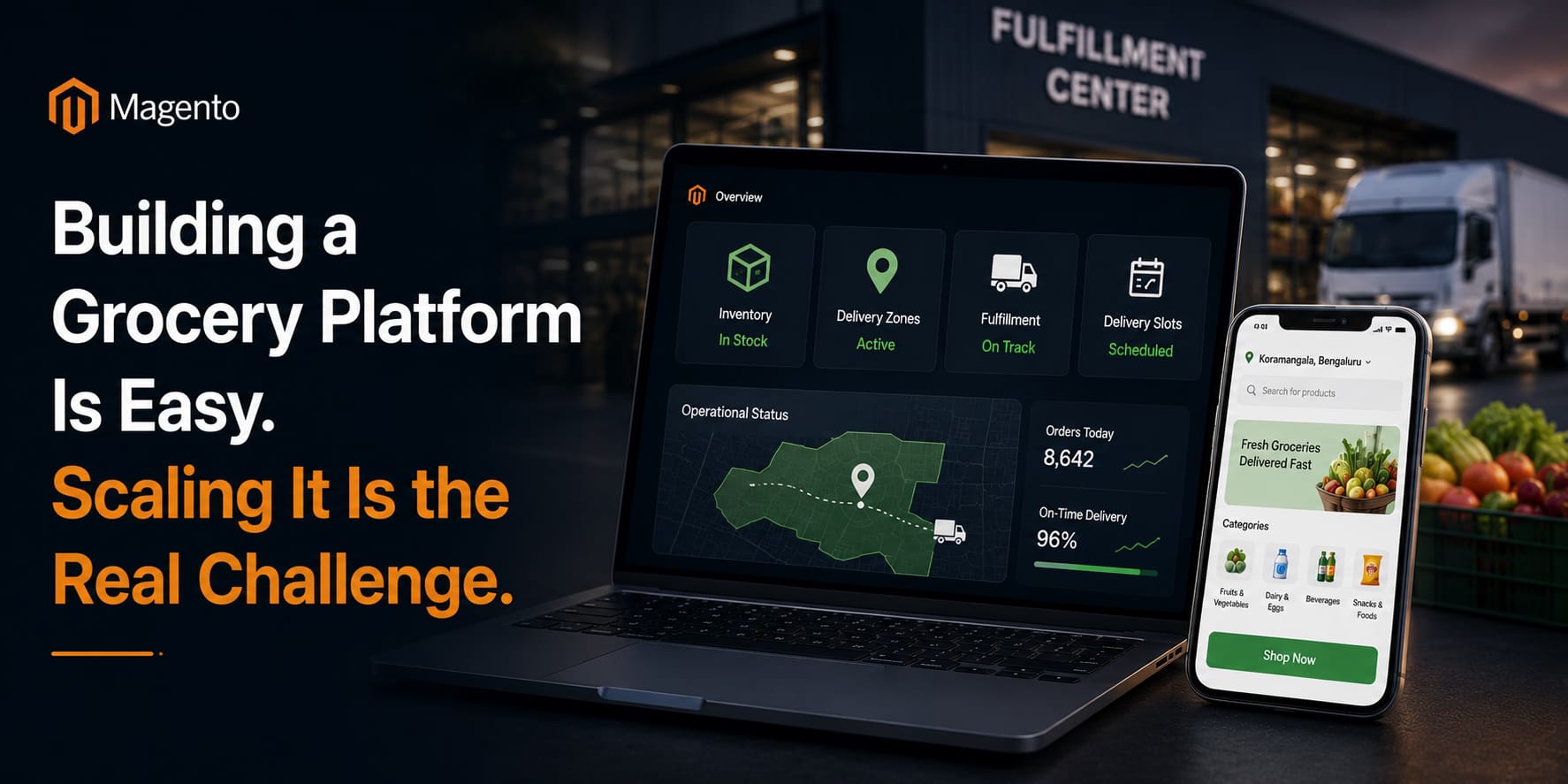
India's online grocery market is growing fast, but many grocery platforms weren't built for the operational demands that come with scale.
What works perfectly well at 500 orders a day often starts breaking at 5,000.
Inventory falls out of sync. Products appear available even after stock is exhausted. Delivery slots become difficult to manage during peak hours. Checkout delays increase, and operations teams end up relying on spreadsheets and manual processes just to keep fulfillment moving.
The challenge isn't demand.
The challenge is that grocery ecommerce behaves very differently from traditional retail.
Table of Contents
- Growth of Online Grocery Businesses in India
- Why Customer Expectations Changed in Grocery Ecommerce
- Why Many Grocery Platforms Struggle as Operations Grow
- Why Magento Works Well for Online Grocery Businesses
- Why Delivery Slot Management Becomes Difficult at Scale
- Why Inventory Accuracy Matters in Grocery Ecommerce
- Why Mobile Performance Matters for Grocery Websites
- Core Capabilities Required in Modern Grocery Delivery Platforms
- Common Challenges Growing Grocery Businesses Face
- How Navigate Commerce Helps Grocery Businesses Scale
- Why Grocery Websites Need Ongoing Optimization
- Final Thoughts
- Frequently Asked Questions
Unlike fashion or electronics stores, grocery businesses depend on constantly changing inventory, recurring purchases, location-based availability, and coordinated fulfillment across multiple delivery locations. These requirements expose the limitations of platforms that were never designed for hyperlocal operations.
This is one of the reasons many growing grocery businesses eventually move toward Magento and Adobe Commerce. Businesses planning long-term expansion often invest in professional Magento Development Services to build platforms that can support increasing order volume and changing operational requirements.
Magento gives businesses greater flexibility over inventory management, fulfillment workflows, integrations, and platform scalability without forcing them into rigid ecommerce structures.
In this guide, we'll look at what changes as grocery businesses grow, where many platforms struggle, and why Magento continues to be a strong choice for businesses planning long-term expansion.
Growth of Online Grocery Businesses in India
Online grocery ordering in India has evolved rapidly over the last few years. What was once viewed as a convenience service has become an everyday shopping habit for millions of customers.
Industry reports from RedSeer, Bain & Company, and other market researchers continue to show strong growth in digital grocery ordering, driven by increasing smartphone usage, improved payment infrastructure, and changing customer expectations around convenience.
Customers today expect grocery platforms to provide:
- Accurate inventory visibility
- Faster order processing
- Reliable delivery coordination
- Flexible delivery windows
- Smooth mobile experiences
This shift has changed grocery websites from simple ecommerce stores into operational systems that must continuously coordinate inventory, fulfillment, and delivery.
Unlike many traditional ecommerce categories, grocery businesses deal with challenges such as:
- Fast-moving inventory
- Perishable products
- Recurring purchases
- Location-based stock availability
- Delivery slot management
- High-frequency ordering behavior
A grocery website that performs well during the early stages of growth may begin facing challenges once order volume increases across multiple delivery zones and fulfillment locations.
That is why many businesses planning long-term growth invest in scalable ecommerce architecture rather than relying only on basic storefront capabilities.
Why Customer Expectations Changed in Grocery Ecommerce
Customer expectations in grocery ecommerce changed significantly because shopping behavior itself changed.
A few years ago, customers were comfortable waiting one or two days for deliveries as long as products were available at reasonable prices. Today, customers expect convenience throughout the entire buying journey.
They expect grocery platforms to instantly answer questions such as:
- Is the product available near me?
- Can it be delivered today?
- Which delivery slot is available?
- Is stock information accurate?
This change was driven by three major factors.
First, Mobile ordering became the preferred shopping method for many customers. Grocery purchases are often made during short moments throughout the day rather than during long browsing sessions.
Second, Repeat ordering behavior increased. Unlike electronics or fashion purchases, grocery buying is frequent and predictable. Customers expect speed because they already know what they want.
Third, Improvements in delivery infrastructure raised customer expectations. Faster and more reliable fulfillment changed what customers consider normal.
As a result, grocery websites are no longer just digital catalogs. They are operational platforms that must coordinate inventory visibility, fulfillment, delivery schedules, and customer experience in real time.
Businesses that fail to meet these expectations often experience lower customer retention and reduced repeat purchases.

Why Many Grocery Platforms Struggle as Operations Grow
Many grocery businesses start with platforms that work perfectly well during the early stages of growth. Problems usually appear later when order volume increases, delivery zones expand, and inventory movement becomes more dynamic.
Managing a few hundred orders per day is very different from handling thousands of orders across multiple locations.
As operations grow, grocery businesses need to coordinate several moving parts simultaneously:
- Inventory availability
- Delivery windows
- Order routing
- Pincode-based serviceability
- Customer notifications
- Payment and fulfillment systems
Most lightweight ecommerce platforms were originally designed for standard retail workflows where inventory changes less frequently and fulfillment requirements are relatively simple.
Grocery businesses operate differently.
Products move quickly, stock levels change continuously, and customers expect orders to be fulfilled accurately and on time. Even small delays in updating inventory or allocating delivery slots can affect customer experience.
Businesses often try solving these challenges with plugins, manual workarounds, spreadsheets, or disconnected third-party systems. While these solutions may address individual problems, they rarely solve the underlying scalability issues.
This is one of the reasons many growing grocery businesses eventually move toward platforms that provide more flexibility and control over operations instead of continuously adding temporary fixes.
Why Magento Works Well for Online Grocery Businesses
Launching an online grocery store is relatively straightforward. The real challenge begins when operations become larger and more demanding.
As order volume increases, grocery businesses require better inventory visibility, stronger integrations, and greater flexibility to support changing operational requirements.
Magento has remained a popular choice for growing businesses because it provides the flexibility required to adapt as operations evolve.
Unlike many platforms that focus primarily on storefront experience, Magento allows businesses to build workflows around how they actually operate.
Multi-Source Inventory (MSI)
Inventory is one of the biggest challenges in online grocery operations. Many businesses manage stock across warehouses, dark stores, or local fulfillment centers.
Magento's Multi-Source Inventory framework helps businesses maintain better stock visibility and allocate inventory across multiple locations more efficiently.
This becomes especially important when products are fulfilled from different locations depending on customer demand and service areas.
Flexible Catalog Management
Grocery businesses often manage thousands of SKUs across categories such as fresh produce, packaged foods, dairy products, beverages, and household essentials.
Magento supports:
- Configurable products
- Bundled products
- Custom attributes
- Category hierarchies
- Advanced merchandising
These capabilities help businesses organize large catalogs while improving product discovery and navigation.
Integration Flexibility
Modern grocery operations depend on several systems working together.
Magento integrates with:
- ERP systems
- POS software
- Warehouse management systems
- Payment gateways
- Delivery management platforms
- Customer engagement tools
These integrations help businesses automate workflows and reduce manual intervention.
Subscription and Repeat Ordering
Grocery purchases are highly repetitive. Customers often buy the same products every week.
Magento supports reorder workflows, subscriptions, customer segmentation, and promotional campaigns that help improve repeat purchases and customer retention.
Hyvä for Faster Mobile Performance
Mobile traffic dominates online grocery shopping. Customers expect pages to load quickly and checkout to work without friction.
Hyvä themes help businesses improve page speed, browsing experience, checkout performance, and mobile usability. Many businesses looking to deliver faster storefront experiences also invest in Hyvä Theme Development Services to improve performance and customer experience.
This allows customers to complete purchases faster and encourages repeat ordering.
These capabilities make Magento a practical choice for businesses planning long-term growth rather than short-term deployment.
Why Delivery Slot Management Becomes Difficult at Scale
Delivery slot management becomes significantly more challenging as grocery operations expand across multiple locations and customer demand increases.
During the early stages of growth, businesses can often manage deliveries manually or with basic scheduling systems. However, as order volume grows, delivery coordination becomes much more complex.
Several factors influence delivery availability:
- Location of the customer
- Inventory availability nearby
- Delivery capacity
- Route planning
- Traffic conditions
- Order volume during peak hours
For example, two customers ordering the same product may require completely different fulfillment decisions depending on which location has inventory and which delivery slots remain available.
Without proper coordination, businesses often experience:
- Overbooked delivery windows
- Delayed orders
- Inefficient routing
- Operational bottlenecks
- Increased customer complaints
These issues become even more visible during weekends, holidays, and promotional campaigns when order volume increases sharply.
This is why delivery logic and fulfillment workflows become important architectural considerations for growing grocery businesses rather than simple operational tasks.
Why Inventory Accuracy Matters in Grocery Ecommerce
Inventory accuracy directly affects customer trust, repeat purchases, and operational efficiency.
Unlike many retail categories where stock levels change slowly, grocery inventory is constantly moving because of daily replenishment, perishables, and location-based fulfillment.
Customers expect product availability shown on the website to match what can actually be delivered.
When inventory data becomes inaccurate, businesses often experience:
- Overselling
- Order cancellations
- Product substitutions
- Delayed deliveries
- Customer dissatisfaction
These problems not only affect day-to-day operations but also reduce trust and repeat ordering behavior.
Inventory synchronization becomes even more challenging when businesses operate across multiple warehouses, dark stores, or fulfillment centers.
Stock movement depends on several factors:
- Incoming inventory
- Order volume
- Supplier replenishment
- Spoilage and wastage
- Local demand
This is why inventory management is no longer just a backend process.
For modern grocery businesses, inventory accuracy has become an important part of customer experience and long-term growth.
Why Mobile Performance Matters for Grocery Websites
Most grocery purchases happen on mobile devices, and customer behavior in grocery ecommerce is very different from many other retail categories.
Customers usually know what they need and want to complete their orders quickly. They are not looking to spend time browsing products or researching specifications.
Many purchases happen during short moments throughout the day:
- Commuting
- Office breaks
- Meal planning
- Repeat household ordering
This makes speed and convenience extremely important.
Slow pages, poor search performance, or friction during checkout can quickly lead to abandoned orders.
Customers expect:
- Fast page loading
- Smooth product search
- Responsive navigation
- Quick checkout
- Reliable performance
Even small delays can affect conversion rates and repeat purchases.
This is one of the reasons many businesses investing in Magento also adopt Hyvä themes and performance optimization strategies.
Faster storefront experiences improve not only customer satisfaction but also order completion rates and long-term customer retention. This is why many growing businesses invest in eCommerce Performance Optimization Services to improve page speed, checkout performance, and mobile usability.
For grocery businesses, mobile performance is no longer just a technical metric. It directly affects revenue and customer loyalty.
Core Capabilities Required in Modern Grocery Delivery Platforms
Launching an online grocery store is no longer just about displaying products and processing payments. As operations become more complex, businesses need systems that can support inventory visibility, fulfillment coordination, and high-frequency ordering without creating operational bottlenecks.
The capabilities required by a modern grocery platform are very different from those needed by traditional ecommerce businesses.
For example, grocery businesses often deal with changing inventory, location-based serviceability, recurring purchases, and multiple fulfillment locations. These requirements demand a more flexible architecture.
The following capabilities become increasingly important as businesses grow:
| Capability | Why It Matters |
|---|---|
| Multi-location inventory management | Improves stock visibility across warehouses and dark stores |
| Pincode-based delivery logic | Prevents orders from non-serviceable locations |
| Delivery slot management | Balances order volume and fulfillment capacity |
| Weight-based products | Supports fresh produce and variable quantities |
| Subscription and repeat ordering | Encourages customer retention |
| Mobile-first experience | Improves ordering convenience |
| ERP and POS integrations | Reduces manual operations |
| Performance optimization | Supports higher traffic and better conversions |
| Flexible promotions and pricing | Helps run offers and loyalty campaigns |
| Scalable infrastructure | Supports long-term business growth |
As customer expectations continue evolving, these capabilities become essential for maintaining operational efficiency and delivering a reliable shopping experience.
Common Challenges Growing Grocery Businesses Face
Many grocery businesses do not encounter major problems immediately after launching their websites.
The real challenges usually appear when order volume increases and operations become more demanding.
Several issues commonly emerge during growth:
Inventory Mismatch
Products may appear available even though local inventory has already been exhausted. This often results in cancellations and poor customer experience.
Fulfillment Delays
As delivery zones expand, coordinating inventory and delivery resources becomes increasingly difficult. Manual processes quickly become inefficient.
Slow Website Performance
Higher traffic and larger product catalogs can affect browsing speed and checkout experience, especially on mobile devices.
Disconnected Systems
When ERP systems, warehouse software, payment gateways, and ecommerce platforms are not properly integrated, businesses often rely on manual processes to manage operations.
Delivery Slot Conflicts
Growing order volume can create bottlenecks when delivery schedules are not managed effectively.
Limited Platform Flexibility
Many businesses discover that their current platforms restrict custom workflows and make it difficult to adapt to changing operational requirements.
These challenges are usually symptoms of growth rather than isolated technical problems.
Businesses that address these issues early are often better positioned to scale efficiently without compromising customer experience.
How Navigate Commerce Helps Grocery Businesses Scale
Launching an online grocery platform is only the beginning. As businesses grow, operational requirements become more demanding, and technology decisions start having a direct impact on customer experience, operational efficiency, and long-term scalability.
At Navigate Commerce, we help grocery businesses build, optimize, and scale ecommerce platforms that support both current operations and future growth. Our team combines Magento expertise with practical experience in ecommerce architecture, integrations, and performance optimization to create solutions tailored to the unique requirements of grocery retail.
Magento Development for Grocery Ecommerce
We develop custom Magento solutions designed to support the complexities of online grocery operations. From managing large product catalogs to handling location-based delivery requirements, our solutions are built to provide flexibility and scalability.
Custom Features and Workflow Development
Every grocery business operates differently. We help businesses implement custom functionality such as:
- Delivery slot management
- Pincode-based serviceability
- Weight-based product pricing
- Subscription and recurring orders
- Multi-store and multi-location inventory management
- Personalized promotions and loyalty programs
These capabilities help businesses deliver better customer experiences while improving operational efficiency.
Third-Party Integrations
Modern grocery businesses rely on multiple systems working together. We help integrate Magento with:
- ERP systems
- POS solutions
- Warehouse management systems
- Payment gateways
- Shipping and logistics providers
- CRM and marketing automation platforms
These integrations reduce manual work and improve data accuracy across operations.
Performance Optimization and Scalability
Website speed and reliability are critical for customer retention. Our team focuses on:
- Magento performance optimization
- Faster page load times
- Mobile experience improvements
- Server and infrastructure optimization
- Database tuning
- Scalability planning for growing traffic and order volumes
This helps businesses maintain a smooth shopping experience even during peak demand periods.
Ongoing Support and Maintenance
Technology requirements continue evolving after launch. We provide ongoing support to help businesses:
- Maintain platform stability
- Apply security updates
- Monitor performance
- Resolve technical issues
- Implement new features as business needs change
Our goal is to ensure that ecommerce platforms continue supporting growth without disrupting daily operations.
Partnering for Long-Term Growth
Whether you are launching a new online grocery store or looking to improve an existing platform, having the right technology partner can make a significant difference.
At Navigate Commerce, we work with businesses to create scalable Magento solutions that support efficient operations, better customer experiences, and sustainable growth.
If you're planning to build or scale an online grocery business, our team can help you develop a platform that is ready for the demands of modern grocery ecommerce.
Why Grocery Websites Need Ongoing Optimization
Launching a grocery ecommerce website is only the first step. Customer expectations, order patterns, and operational requirements continue changing as the business grows.
Many businesses assume that most of the work ends after the platform goes live. In reality, ongoing optimization becomes increasingly important because grocery ecommerce operations are constantly evolving.
For example, businesses may need to:
- Improve page speed as traffic increases
- Optimize search and navigation for larger catalogs
- Introduce new delivery workflows
- Support additional fulfillment locations
- Integrate new third-party systems
- Enhance mobile ordering experiences
- Launch subscription programs or loyalty initiatives
Small inefficiencies that go unnoticed during the early stages can eventually affect customer experience, operational efficiency, and repeat purchases.
Performance optimization is equally important. As catalogs expand and traffic grows, websites may experience slower page load times, increased server load, and reduced checkout performance if infrastructure and application layers are not optimized properly.
Businesses also need to keep pace with changing technology requirements, security updates, and evolving customer expectations.
This is why many growing grocery businesses increasingly invest in performance optimization, operational monitoring, infrastructure scalability, backend workflow improvements, and ongoing Magento Support & Maintenance Services to ensure their platforms continue supporting business growth.
Continuous improvement helps businesses maintain stability, improve conversions, and ensure that their platforms remain capable of supporting future growth.
Final Thoughts
The growth of online grocery businesses in India has changed what customers expect from ecommerce platforms.
Customers no longer evaluate grocery websites based only on product availability or pricing. They expect accurate inventory information, convenient ordering experiences, reliable fulfillment, and smooth mobile interactions.
Meeting those expectations requires much more than a basic storefront.
As businesses expand, challenges related to inventory management, delivery coordination, performance, and integrations become increasingly important. These operational requirements often expose the limitations of platforms that were designed primarily for standard retail workflows.
Magento continues to be a strong choice for grocery businesses because it provides the flexibility needed to support changing business requirements, integrate with critical systems, and scale as operations grow.
The most successful grocery businesses do not simply invest in launching a website. They invest in building a platform that can support long-term growth, adapt to changing customer expectations, and deliver reliable experiences across every stage of the buying journey.
For businesses planning to build, optimize, or scale their online grocery operations, choosing the right ecommerce architecture today can help avoid costly limitations tomorrow.

Frequently Asked Questions
Is Magento a good platform for grocery ecommerce businesses in India?
Yes. Magento is well suited for grocery ecommerce because it provides the flexibility required to support large product catalogs, multi-location inventory, custom delivery workflows, third-party integrations, and long-term scalability. Businesses with complex operational requirements often prefer Magento because it can be customized to fit their processes instead of forcing them into predefined workflows.
Can Magento support hyperlocal grocery delivery and pincode-based serviceability?
Yes. Magento can support hyperlocal delivery models through custom development and integrations. Businesses can implement pincode-based serviceability, delivery slot management, location-aware inventory, and multi-store fulfillment workflows to support local delivery operations.
Does Magento support inventory management across multiple warehouses or dark stores?
Magento includes Multi-Source Inventory (MSI), which allows businesses to manage stock across multiple locations. This capability helps improve inventory visibility and enables businesses to allocate orders more efficiently based on product availability and fulfillment requirements.
Why do many grocery ecommerce platforms struggle as businesses grow?
Many platforms work well during the early stages of growth but start facing challenges as operations become more complex. High order volume, frequent inventory changes, delivery coordination, and integrations with external systems require greater flexibility and scalability than some platforms can provide.
Why is mobile performance important for online grocery businesses?
Most grocery orders are placed on mobile devices. Customers expect fast page loading, smooth navigation, and frictionless checkout experiences. Slow websites often lead to abandoned orders and lower repeat purchases, making performance optimization a critical part of grocery ecommerce success.
What integrations are commonly required for grocery ecommerce websites?
Modern grocery businesses often integrate their ecommerce platforms with ERP systems, POS solutions, warehouse management systems, payment gateways, CRM platforms, and logistics providers. These integrations help automate operations and improve data accuracy across the business.
How much does it cost to build a grocery ecommerce website on Magento?
The cost depends on factors such as catalog size, custom functionality, integrations, delivery workflows, mobile app requirements, and infrastructure needs. Businesses with advanced requirements such as hyperlocal delivery, subscription ordering, and multi-location inventory management generally require larger investments compared to standard ecommerce websites.